5 Exercises to Build Grip Strength for Pole
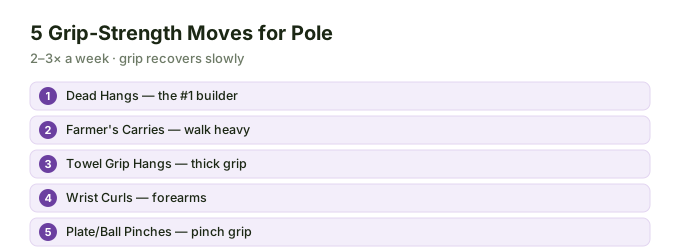
Quick Answer: Weak grip is the most common reason pole moves fail — your hands fatigue before your body does. Train grip 2–3 times a week with dead hangs, farmer’s carries, towel hangs, wrist curls, and plate pinches. Most people notice noticeably more secure holds in 4–6 weeks, because grip strength responds fast when you train it directly.
Every pole dancer hits the same wall early. Your body is ready for the move, your shoulders are strong enough, your core is holding — and your hands quietly announce, “Nope, we’re done.”
Grip is the silent gatekeeper of pole. It’s also one of the most trainable qualities in the whole sport, which is genuinely good news: weak grip today, iron grip in about six weeks.

Why Is Grip the Bottleneck in Pole?
Pole asks your hands and forearms to hold your entire body weight — often inverted, often on a single point of contact, often for 10 to 30 seconds at a stretch. That’s a bigger demand than almost anything else you do in a week.
The problem is that grip is rarely trained on purpose. You use it constantly and strengthen it accidentally, so it lags behind the muscles you actually train. When your lats and core can hold a climb for 40 seconds but your hands quit at 12, your hands set the ceiling.
There’s a second issue nobody warns you about: grip is three different things.
- Crush grip — closing your hand around the pole. This is what most people mean by “grip.”
- Support grip — holding a closed position over time. This is what fails during climbs and hangs.
- Pinch grip — thumb against fingers, no wrapping. This is what leg hangs and some hand grips actually rely on.
Train only crush grip and you’ll still slip in the positions that need pinch and support. The five exercises below cover all three.
The 5 Grip Exercises for Pole
1. Dead Hangs
Hang from a pull-up bar (or the pole) with straight arms and shoulders slightly engaged — not fully relaxed. Boring, brutal, brilliant, and the single best support-grip builder there is.
Do this: 3 sets of a max hold, resting 90 seconds between. Start where you are — 15 seconds is a real starting point. Aim to build toward a 60-second hang.
2. Farmer’s Carries
Grab something heavy in each hand — dumbbells, kettlebells, two loaded grocery bags — and walk with your shoulders down and ribs stacked over hips. Your forearms will be screaming by the second lap. That’s the point, and it also builds the shoulder stability that pole holds need.
Do this: 4 rounds of 30–40 metres, resting 60 seconds. Go heavy enough that the last five steps are a genuine fight.
3. Towel Grip Hangs
Loop a towel over a bar and hang from the ends. The thicker, unstable, shifting surface forces your hands to work far harder than a fixed bar does — and it’s the closest gym drill to the way a pole rotates under your hand.
Do this: 3 sets of 10–20 seconds. This one gets humbling fast; expect roughly half your normal dead-hang time.
4. Wrist Curls
Forearm resting on your thigh or a bench, palm up, light dumbbell, curl at the wrist only. Then flip to palm-down for reverse curls. This builds the forearm flexors and extensors that keep your hand locked to the pole under rotation.
Do this: 2 sets of 12–15 each direction with a light weight — 2 to 5 kg is plenty. Full range, slow lowering.
5. Plate or Ball Pinches
Pinch a smooth weight plate (or two plates smooth-side-out) between thumb and fingers and hold it at your side. This trains pinch grip, the one nobody trains and the one leg hangs quietly depend on.
Do this: 3 sets of 20–30 second holds per hand. Start with 5 kg and add slowly.
What Nobody Tells You About Grip Training
Grip recovers slowly. It’s dense connective tissue and small muscles, and it takes 48 hours or more. Training it hard the day before a pole session actively makes your pole session worse — the most common mistake by a wide margin.
Skin is a separate limiter. Sometimes it isn’t strength, it’s that your palms are raw or slick. Grip aid, a proper warm-up so your hands are dry, and letting torn skin fully heal do more for a bad grip day than any exercise.
Grip strength shows up in weeks, not months. Because most people have never trained it directly, the early gains are dramatic — 30 to 50 percent improvements in hang time inside six weeks are ordinary.
Your thumb matters more than you think. Wrapping the thumb around a bar or pole recruits far more force than a “false grip.” If you’ve been hanging thumbless out of habit, fixing that alone is worth a few seconds of hold time.
How to Train Grip Without Wrecking Your Pole Days
- 2–3 sessions a week, and never the day before a hard pole class.
- Put grip work at the end of a session, not the start — fried hands make everything before them worse.
- Quality over ego. A controlled 20-second hold beats a flailing 8-second one with more weight.
- Deload when your elbows complain. Medial elbow pain is the classic sign of too much grip volume too fast; back off to one session a week for two weeks.
- Track one number. Max dead hang, tested every two weeks, tells you everything about whether the plan is working.
If you have persistent numbness, tingling, or elbow or wrist pain that lasts beyond normal soreness, see a physiotherapist or doctor — grip training shouldn’t hurt joints, and nerve symptoms aren’t something to train through.

FAQ
How long until my grip improves for pole?
Most people feel a difference in 4 weeks and see a measurable one — longer holds, less slipping — by week 6 to 8. Grip responds unusually fast because so few people have ever trained it directly.
Should I use grip aid or just train harder?
Both, for different problems. Grip aid fixes sweat and slip. Training fixes fatigue. If you’re solid for 5 seconds and then slide, that’s aid. If you’re solid and then your hand simply opens, that’s strength.
Can I train grip if I don’t have a gym?
Easily. Dead hangs need a doorway bar. Farmer’s carries work with grocery bags or water jugs. Towel hangs need a towel. Pinches work with a stack of books held between thumb and fingers. None of the five exercises requires a gym membership.
TL;DR:
- Grip is usually the real limiter in pole — your hands quit before your body does
- Train all three types: crush, support, and pinch
- The five: dead hangs, farmer’s carries, towel hangs, wrist curls, plate pinches
- 2–3 sessions a week, at the end of workouts, never the day before pole
- Expect noticeably better holds in 4–6 weeks
- Elbow or wrist pain means back off, not push through
Keep Reading
This article is for general informational and styling purposes only. Fit, sizing, and product availability may vary — check current details before purchasing.