Pole Dance for Beginners: Your First-Class Survival Guide
You booked the class. Now you’re picturing two scenarios on a loop: the effortless spin you saw on Instagram, and sliding straight down the pole in front of a room of strangers.
Neither is what happens. Let’s replace the anxiety with an actual plan.
Quick Answer: Wear grip shorts and a sports bra — skin contact is what grips the pole — and no lotion or oil that day. You will not be inverting in your first class; expect a warm-up, one or two basic spins, a walk-around, and a stretch. Bruises on your shins and inner arms (“pole kisses”) are completely normal and fade as you adapt. Arrive early, eat lightly, and plan to come back — strength builds surprisingly fast.

What Should You Wear and Bring to Your First Pole Class?
Grip shorts and a sports bra. This one confuses people, so here’s the reason: your skin is what grips the pole. Fabric slides. Spins and holds rely on contact between the pole and the backs of your knees, your inner thighs, your armpits, and your hands. Covered skin can’t grip, and you’ll slide off moves you’d otherwise hold.
You’ll feel exposed for about ten minutes and then stop noticing entirely, because everyone else is dressed the same way and everyone is busy not falling over.
For a genuine first class, standard athletic shorts and a sports bra are fine — no need to buy anything specific before you know you like it.
No lotion, oil, or body butter that day. Slippery skin is the enemy, and moisturizer applied that morning is still on your skin at 7pm. Skip it entirely, including on your legs and arms.
Also bring:
- Water
- Knee pads if you have them (optional, appreciated during floor work)
- A layer for warming up and cooling down
And do:
- Arrive a few minutes early to meet the instructor, mention any injuries, and claim a pole.
- Eat lightly beforehand. Nothing heavy — you’ll be spinning, and eventually upside down.
- Take off rings, bracelets, and watches. They scratch the pole and interfere with grip.
What Actually Happens in a Beginner Pole Class?
Spoiler: you will not be inverting on day one. Nobody expects you to. If a studio is trying to put beginners upside down in week one, that’s a red flag, not a good class.
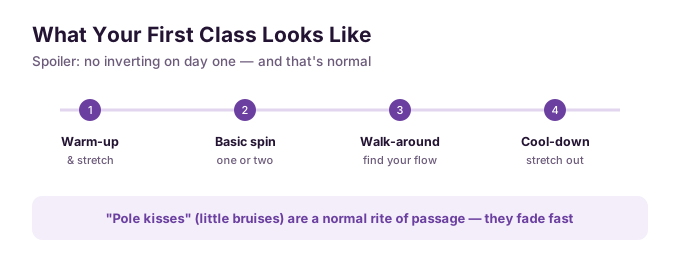
A typical beginner class runs roughly:
- Warm-up (10–15 min) — cardio and mobility, with real attention to shoulders, wrists, and core.
- Conditioning — grip work, holds, and basic strength drills.
- Spins — usually one or two: a fireman spin, maybe a step-around. You’ll drill each one repeatedly on both sides.
- Walk-around — the circular walk around the pole that teaches you how to move with the pole rather than just hang off it. Deceptively hard, weirdly satisfying.
- Floor work and transitions — sometimes.
- Cool-down and stretch (10 min)
It’s playful, it’s a genuine workout, and it’s far more welcoming than films and TV suggest. Beginner classes are typically full of people who are also there for the first or fifth time, and the culture is noticeably supportive — pole studios tend to cheer for each other in a way most gyms don’t.
Are Pole Bruises Normal?
Yes, and they have a name. “Pole kisses” — small bruises on your shins, inner thighs, tops of your feet, and inner arms.
They come from pressing skin against a steel pole hard enough to hold your body weight, which is exactly what you’re supposed to be doing. They’re a sign you’re gripping properly, not a sign you’re doing something wrong.
They also fade fast, and they get less frequent surprisingly quickly as your skin and connective tissue adapt. Most people find the bruising drops off substantially after the first month or two.
Every single person in that room has them, including the instructor.
What isn’t normal: sharp pain during a move, shoulder or wrist pain that lingers past a day or two, or anything that feels like a joint rather than a muscle. Pole loads the shoulders and wrists significantly, and while soreness is expected, joint pain is worth mentioning to your instructor and getting looked at if it persists.
5 Things Nobody Tells You Before Your First Pole Class
1. You will feel awkward, and that’s the assignment. Everyone’s first class is wobbly. The instructor knows this. The people around you are also wobbling. Grace is the goal you’re working toward — it’s not the entry requirement.
2. Grip strength is the real limiter, not upper body strength. Most beginners are surprised that their hands give out before their arms do. It builds quickly, and there’s nothing to do about it except show up.
3. Strength comes shockingly fast. Two or three classes in, moves that felt impossible get noticeably easier. Pole progress in the early weeks is some of the most visible in any discipline, largely because you’re learning technique and building strength at the same time.
4. Grip aids exist and are completely normal. Studios usually have grip products at hand for sweaty or dry hands — ask. Also relevant: humidity and temperature genuinely affect pole grip, so a class that felt secure last week can feel slippery this week through no fault of yours.
5. The bar for a good first class is low, deliberately. One clean spin is a real win. Getting through the warm-up without dying is a real win. Coming back for class two is the biggest one, because pole rewards consistency far more than natural ability.

What Should You Do After Class?
Hydrate. Moisturize — now you can, and your skin will want it after gripping steel for an hour. Stretch, especially shoulders, lats, and hips.
Expect to feel muscles you’d forgotten about, particularly in your lats, forearms, and obliques. Soreness peaks around 24–48 hours. That’s your whole body noticing it did something new.
Book class two before the soreness sets in. This is the single most useful piece of advice here. Pole is a skill with a strength component, and both respond to frequency. One class a week, consistently, beats an enthusiastic burst followed by a three-month gap.
FAQ
Do you need to be strong or flexible to start pole?
No. Beginner classes are designed for people with no prior strength or flexibility background, and both develop through the classes themselves. Grip strength is usually the first limiter for beginners, and it improves quickly with regular attendance.
Why do you have to wear shorts for pole dancing?
Because bare skin grips the pole and fabric slides. Spins and holds depend on contact at the backs of your knees, inner thighs, and armpits — covered skin simply can’t create that friction, and you’ll slip out of moves. It also means no lotion or oil on class day, since residue on your skin has the same effect.
How long does it take to learn to invert?
It varies a lot, but many people work toward inverting over roughly two to four months of consistent classes, depending on frequency and starting strength. Inverting requires real core and shoulder stability, and good studios build that deliberately rather than rushing it — a beginner class that has you upside down in week one is one to be wary of.
TL;DR:
- Grip shorts and a sports bra — bare skin grips the pole, fabric slides.
- No lotion or oil on class day. Morning moisturizer is still there at 7pm.
- You will not invert on day one. Expect warm-up, conditioning, one or two spins, a walk-around, and a stretch.
- Bruises are normal and named (“pole kisses”). They fade fast and get rarer within a month or two.
- Grip strength gives out before arm strength for most beginners — and builds quickly.
- Arrive early, eat lightly, remove rings and bracelets, bring water.
- Book class two before the soreness hits. Consistency beats natural ability here by a wide margin.
- Sharp or joint pain — especially shoulder or wrist — is worth flagging, unlike ordinary muscle soreness.
Keep Reading
This article is for general informational and styling purposes only. Fit, sizing, and product availability may vary — check current details before purchasing.