Why Your Pole Strength Varies Across Your Cycle
Quick Answer: Strength, grip, joint stability, and skin behavior all shift across a typical cycle. Most people find their strongest, most confident pole sessions in the week or so after their period ends, and their hardest sessions in the days just before it starts - when core temperature is higher, perceived effort rises, and grip feels worse. Ligament laxity also varies, which changes how stable a shoulder or knee feels in a hold.
Plan skill acquisition for the strong weeks and conditioning for the difficult ones, rather than fighting the pattern.
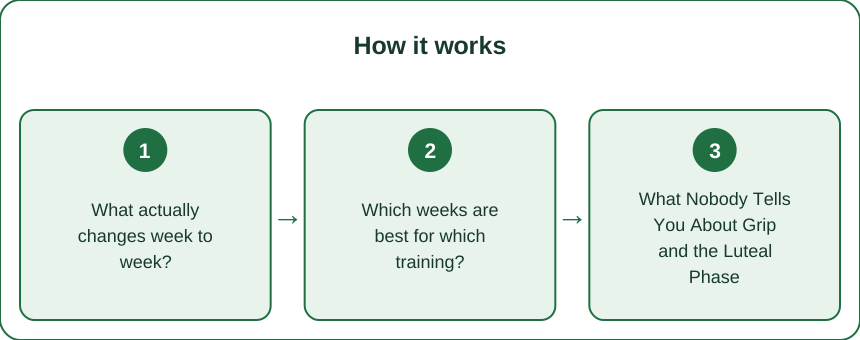
What actually changes week to week?
Several separate systems, and they do not all move together - which is why it can feel confusing rather than like a simple two-week pattern.
Perceived effort. In the phase after ovulation, core body temperature runs slightly higher and thermoregulation is less efficient. The same session feels hotter and harder. This is one of the more consistent findings, and it matters in pole specifically because a hot studio and a hot body both make grip worse.
Grip and skin. Hand and skin moisture varies across the cycle, and many people report noticeably sweatier palms in the days before their period. On a pole, where grip is the limiting factor for most moves, a small change in palm moisture is the difference between holding a spin and sliding out of it. This is probably the single most pole-specific effect.
Joint stability. Estrogen influences connective tissue, and ligament laxity varies across the cycle - it tends to be higher around ovulation. More laxity means a joint feels slightly less locked in, which is most noticeable in overhead shoulder positions and in knee-dependent grips like a knee hold.
Energy availability and mood. Sleep quality, iron status during and after bleeding, and motivation all vary, and they affect training as much as any hormonal effect on the muscle itself.
Bruising and skin sensitivity. Both tend to be more pronounced in the premenstrual phase, and pole is a sport where skin contact under load is the entire technique.
What is worth stating clearly: research on maximal strength across the cycle is genuinely mixed, and the effect sizes on raw force production are small for most people. What is much more consistent is the experience - effort, grip, confidence, and recovery - and in a skill sport those determine your session more than a few percent of maximal force does.
Which weeks are best for which training?
Rough phases, with the caveat that individual variation is large and your own log beats any general schedule.
During your period. Often better than people expect, especially in the last couple of days. Once the first day or two passes, many people report feeling notably strong. Energy may be low if bleeding is heavy or iron is marginal, but grip is frequently good. Reasonable for technique work and moderate conditioning; listen to energy rather than pushing.
The week after (roughly days 6 to 13). The strong window for most people. Rising estrogen, good recovery, lower perceived effort, and generally better grip. This is when to attempt new skills - a first invert, a new grip, a scary transition. Skill acquisition benefits enormously from attempting things on a day when your body cooperates, because the failed-attempt-anxiety loop is what stalls most progress.
Around ovulation (roughly days 13 to 16). Often peak subjective strength, with one caution: ligament laxity peaks around here too. Some people are at their strongest and slightly less stable simultaneously. Good for strength work, worth being a bit more conservative on aggressive shoulder loading and dynamic drops.
The luteal phase (roughly days 17 to 28). The harder weeks. Higher core temperature, higher perceived effort, sweatier grip, more bruising, worse recovery. This is the phase to schedule conditioning, flexibility, choreography, and drilling of skills you already own - work where a bad grip day costs you less. Attempting a new invert here and failing tells you almost nothing about your actual ability.
The genuinely useful move is not following this schedule but tracking your own for three cycles. Note the date, how grip felt on a one-to-ten scale, and whether anything felt easier or harder than expected. Most people find a clear personal pattern within three months, and it frequently differs from the textbook in at least one respect.
What Nobody Tells You About Grip and the Luteal Phase
The grip effect is the one that matters most in pole and the one least discussed, because most cycle-and-training advice is written for running and lifting.
In running, a slightly sweatier week is a minor thermoregulation note. In pole, skin friction against a metal pole is the sport. Every hold, every spin, every climb depends on the coefficient of friction between your skin and the pole, and that coefficient is highly sensitive to moisture. A small amount of moisture increases grip slightly; more than that and it drops sharply.
So a phase that raises core temperature and palm moisture pushes you across that threshold, and the experience is dramatic rather than subtle. A move you own becomes impossible. Because it is a skill you can normally do, the natural interpretation is that you have regressed - which is demoralizing and wrong.
What helps specifically in these weeks:
- Change your grip aid, not your expectations. Different products work at different moisture levels. A drying agent that helps on a sweaty day may be too much on a dry one, and many people benefit from carrying two options rather than one.
- Wipe the pole more often, and wipe it dry. Residue from previous moisture is as much a problem as current sweat.
- Train earlier in the session for grip-dependent skills, before you have warmed up into a sweat, and save floor and conditioning work for later.
- Cool down between attempts rather than repeating immediately. Two minutes of genuine rest with hands off the pole restores more grip than another attempt costs.
- Adjust the studio if you can. A fan or a window makes a measurable difference in these weeks specifically.
And the reframe worth internalizing: a bad grip week is not a strength regression. If you log it, you can see the pattern, and seeing the pattern removes most of the frustration.
How should you adjust your training plan?
Modestly, and around scheduling rather than intensity.
Schedule by phase where you can. If your studio offers a mix of classes, aim skill and progression classes at your strong window and flexibility, conditioning, or choreography at the harder one. If your schedule is fixed, adjust your intent within the class instead - go for a new skill on a good day, refine an existing one on a difficult day.
Do not deload automatically. The evidence for phase-based periodization producing better outcomes than consistent training is not strong, and taking the luteal phase off every month costs you a quarter of your training year. The goal is to match the type of work to the week, not to reduce the amount.
Protect the skin. Bruising is worse premenstrually, and pole bruises come from pressure and friction under load. In those weeks, reduce repetitions of the most contact-heavy moves rather than the total volume, and give sensitive areas a break. Bruising that is genuinely severe, appears without corresponding contact, or takes an unusually long time to fade is worth mentioning to a doctor.
Watch iron if periods are heavy. Persistent fatigue, breathlessness on effort, and unusually poor recovery in a heavy-bleeding cycle are worth investigating rather than training through. This is general information, not medical advice.
Be careful with laxity around ovulation. Not a reason to avoid training, but a reason to be conservative with aggressive dynamic loading of the shoulder and knee, which are the joints pole stresses most in extended positions.
Log it. Three cycles of one-line notes gives you a personal map that no general article can. It is the highest-value thing in this entire piece and it costs about ten seconds a session.
FAQ: Pole Training and Your Cycle, Answered
Does hormonal contraception change this?
Often, yes. Combined hormonal contraception suppresses the natural cycle and generally flattens the variation, so many people on it report much more consistent training. Progestin-only methods vary widely. If you are on contraception and still notice a strong pattern, tracking is still worthwhile - it just may not follow the textbook phases.
Should I skip class during my period?
Only if you feel unwell. Many people find the last days of their period are among their better sessions, and exercise often helps with cramps. Do what suits your comfort - training through and taking a rest day are both reasonable, and neither one is more disciplined than the other.
Is this why my flexibility varies too?
Partly. Ligament laxity varies across the cycle, and many people report a bit more range around ovulation. Temperature and warm-up quality matter more than phase for most flexibility work, so a poor stretch session is more often about being under-warmed than about hormones.
How long before I can see my own pattern?
About three cycles of consistent notes. Two is often enough to spot something, but three tells you whether it repeats. Track the date, a grip score out of ten, and one sentence about how the session felt - anything more elaborate tends to get abandoned.
TL;DR:
- Perceived effort, grip moisture, joint laxity, bruising, and recovery all shift across the cycle - the effect on raw strength is smaller than the effect on experience.
- The week after your period is the strong window; schedule new skills and scary attempts there.
- The luteal phase brings higher core temperature and sweatier palms, which hits pole harder than most sports because grip is the limiting factor.
- A bad grip week is not a strength regression - carry two grip aids, wipe the pole dry, and train grip-dependent skills early in the session.
- Match the type of training to the week rather than reducing the amount, and log three cycles to find your own pattern.
Start a one-line log this week: date, grip out of ten, how it felt. Three cycles and you will stop being surprised. This is general information, not medical advice.
Keep Reading
This article is for general informational and styling purposes only. Fit, sizing, and product availability may vary — check current details before purchasing.