Why Pole Grip Changes in the Last Weeks of Summer
Quick Answer: Grip depends on a narrow band of skin moisture - too dry and there is no adhesion, too wet and you hydroplane - and late August is when the inputs to that balance swing hardest. Outdoor humidity is falling while air conditioning is still running, so studio air can go from muggy to dry within a single week. At the same time your skin is carrying the accumulated effects of a summer of sun, chlorine and salt, which changes how it holds moisture. The fix is to stop using a single grip product and start reading the room, with two options in the bag.
Last Tuesday the pole was so sticky you could not rotate. This Tuesday you slid straight off a move you have held for months.
Same pole, same studio, same body. Late August is the most variable grip period of the year, and understanding why makes it manageable rather than maddening.

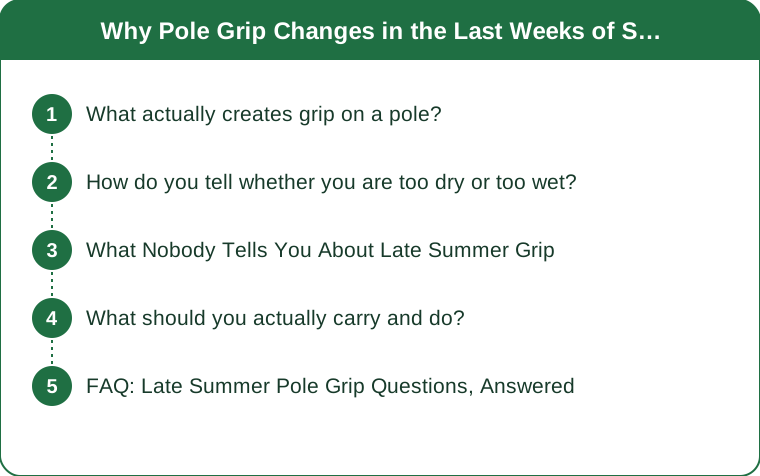
What actually creates grip on a pole?
A very thin film of moisture between skin and metal - and the amount matters enormously.
Completely dry skin against chrome has surprisingly little friction. A microscopically thin layer of moisture increases friction substantially by increasing the real contact area between the soft skin and the hard surface. Add more moisture than that and you get a fluid layer that separates the two surfaces, and friction collapses.
The usable window is narrow, which is why grip feels so binary - either it works or it does not, with very little in between.
Temperature matters through two paths. Warm skin sweats more, moving you toward the wet end. And a cold pole causes condensation - warm humid studio air hitting a cool chrome surface deposits water on it, which is why the first pole of the morning in an air-conditioned studio can be slick before anyone has touched it.
This is the specific late-August problem. Air conditioning cools the metal below the dew point of the room air, and in a humid studio that means an invisible film on the pole. Wiping it down helps for about two minutes.
Skin condition is the other half. Sun exposure, chlorine and salt water all change the stratum corneum - the outer skin layer - making it drier and often more fragile. Skin that has been in a pool three times a week all summer holds moisture differently than it did in May, and that shows up as grip that behaves differently for no apparent reason.
How do you tell whether you are too dry or too wet?
They feel different, and the fix for each makes the other worse.
Too wet feels like a sudden, smooth slide - no warning, no progressive loss. The skin glides. You will often see a visible mark left on the pole. It is worse on the inner thigh and the underarm, where sweat accumulates, and it gets worse as the session goes on.
Too dry feels like squeaking, catching and then releasing. The grip is inconsistent rather than absent, and it is often accompanied by the skin feeling tight or tender. It is worse at the beginning of a session, before you have warmed up, and worse on the hands than the legs.
The fixes are opposite. Too wet needs a drying agent - alcohol-based grip, chalk, antiperspirant applied the night before to problem areas. Too dry needs a tacky agent - a wax or resin-based grip that adds adhesion rather than removing moisture.
Using a drying grip on dry skin is the most common late-August mistake, because most people default to whatever they used in July. In July they were sweating. In late August, with the AC running and the outdoor humidity falling, many people have flipped to the dry end without noticing.
Test before you commit: press your palm flat against the pole and pull it slowly away. A clean quiet release with no tack means dry. A slide means wet. Do this at the start of every session in transitional weather and it takes five seconds.

What Nobody Tells You About Late Summer Grip
Your grip products have a shelf life and a temperature history. A tacky grip that has been in a hot car all summer is not the same product it was in May - the wax base separates and the consistency changes. If your reliable product suddenly behaves oddly, check whether it lived in a bag in a hot car.
The pole temperature matters more than the room temperature. Chrome, brass, stainless and powder-coated poles all hold and release heat differently, and a pole against an exterior wall or under an air conditioning vent is measurably colder than one in the middle of the room. If one pole in the studio is always slippery, it is probably the location, not the pole.
Moisturizer timing is a real variable. Applying lotion the same day as training is the most common cause of unexplained slipping, and it can persist through washing. If you moisturize - and after a summer of sun damage you should - do it after training, not before, and keep it off the hands and inner thighs on training days.
Hydration status changes your sweat composition, not just the volume. Dehydrated sweat is saltier, and salt residue changes how the skin interacts with the pole and with grip products. Late-August dehydration is common and its grip effects are underappreciated.
Skin that has been sunburned or chlorine-exposed all summer is more fragile. Grip aids that were fine in May can sting or irritate now. This is not a sign of a bad product - it is a sign that the skin barrier needs a few weeks of recovery, and that is worth respecting rather than pushing through.
What should you actually carry and do?
Two grip products, and a five-second diagnostic.
Carry one drying and one tacky option. This is the single change that resolves most of the frustration, because it means you are responding to today’s conditions rather than to your default. A small alcohol-based grip and a small wax-based one fit in any bag.
Do the palm-press test at the start of every session and pick accordingly. In stable weather you will always pick the same one. In late August you will not, and that is the whole point.
Warm up longer. A properly warm body sweats predictably; a cold one sweats unpredictably and grips inconsistently. Ten minutes of general warm-up before any grip-dependent work does more for consistency than any product.
Wipe the pole with alcohol, not water, and let it fully evaporate. Water leaves residue and takes longer to clear. And wipe between every set, not just at the start - your own skin oils transfer continuously.
Give your skin a recovery month. Late August into September is the right time to reduce chlorine exposure if you can, moisturize consistently on non-training days, and be patient with grip while the barrier recovers. A lot of what feels like a technique regression in early autumn is skin that had a hard summer, and it resolves on its own within a few weeks.
FAQ: Late Summer Pole Grip Questions, Answered
Why is the pole slippery before anyone has touched it?
Condensation. Air conditioning cools the metal below the dew point of the humid room air, and water forms on the surface. Wiping with alcohol helps briefly but it will re-form while the temperature difference persists. Raising the studio temperature slightly or letting the pole warm up before class is the real fix.
Can I use both a drying and a tacky product together?
Some people layer a drying agent first and a tacky one over it, and it works for hands where sweat and grip demand are both high. It rarely works on legs. Test it in a low-risk session rather than discovering the interaction on an invert.
Is it normal for grip to get worse as I get better?
Surprisingly, often yes - because more advanced work uses more skin-on-pole contact in places that sweat more, and holds positions longer. It is a change in demand, not a regression. The answer is usually more targeted grip management rather than more strength.
TL;DR:
- Grip needs a thin moisture film - too dry and too wet both fail, and they feel completely different.
- Late August swings the inputs hard: falling outdoor humidity plus AC still running.
- Condensation on cold chrome is why a pole can be slick before anyone touches it.
- Do the palm-press test at the start of every session and pick your product from the result, not from habit.
- Carry both a drying and a tacky grip. This single change solves most of it.
- Moisturize after training, not before, and give summer-damaged skin a few weeks to recover.
You did not lose the move. The friction coefficient changed, and it changes back.
Keep Reading
This article is for general informational and styling purposes only. Fit, sizing, and product availability may vary — check current details before purchasing.